
railway-usa.com
22
'26
Written on Modified on
Stadler Unveils First U.S. Battery-Electric FLIRT Train at APTA EXPO 2026
Trainset for Metra enables zero-emission operation on non-electrified corridors, using onboard lithium-ion batteries and flexible charging options for regional rail.
stadlerrail.com
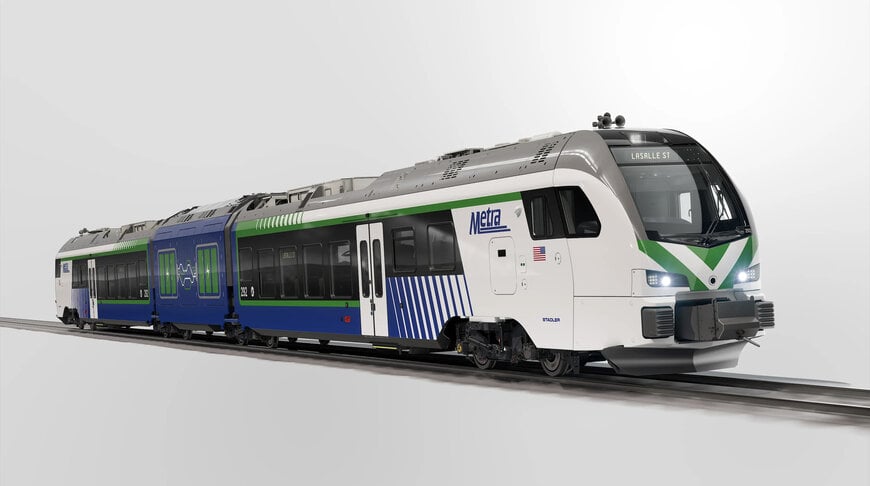
Stadler is manufacturing zero-emission battery-electric multiple unit trainsets for Chicago commuter rail operator Metra to operate on non-electrified passenger rail corridors in northeast Illinois. Under an eight-trainset procurement order scheduled to enter revenue passenger service by 2028, the transit agency is adopting alternative traction technology to decarbonize regional transit networks without constructing overhead catenary systems.
Technical Architecture and Corridor Decarbonization Mechanisms
The vehicle architecture uses the established FLIRT modular platform integrated with onboard lithium-ion traction battery packs. This configuration allows electric multiple units to operate across non-electrified alignments without generating point-of-use exhaust emissions. Kinetic energy recovery through regenerative braking returns electrical energy to the battery banks during deceleration, which reduces total grid energy demand and decreases mechanical brake friction and wear.
In commercial service, multiple-unit configurations offer operational advantages over diesel-locomotive-hauled coaches, including superior tractive effort distribution, higher starting acceleration rates, and reduced operational noise. In Germany, Stadler FLIRT Akku trainsets entered revenue service in 2023 across partially electrified networks in Schleswig-Holstein, validating the capability of battery multiple units to replace regional diesel railcars under sustained timetable conditions.
Operational Flexibility and Depot Energy Management
The traction system accommodates variable charging protocols to prevent the heavy capital expenditure typically required for full-route electrification. The trainsets can draw power from standard 480 V three-phase utility cabling already present in storage yards and terminal tracks, as well as from dedicated high-power wayside charging systems. This multimodal charging design permits fleet deployment on outlying branches where high-voltage substation installation is financially unfeasible.
Metra Executive Director and Chief Executive Officer Jim Derwinski noted that the equipment acquisition reflects the agency's strategy to deploy cleaner, quieter traction systems while establishing operational adaptability for long-term fleet replacement. Northern Illinois Transit Authority Chairman Tom Kotarac emphasized that as transit governance restructuring proceeds across northeast Illinois, the battery trainsets provide the technical capacity to expand route frequency, improve regional connectivity, and reduce localized air pollution and trackside noise.
Transit Network Modernization and Industry Presentation
The integration of battery-electric rolling stock targets the elimination of legacy diesel locomotive emissions in densely populated urban zones and suburban corridors. Modernization of these routes directly lowers nitrogen oxides and particulate matter emissions along the right-of-way.
Stadler North America Chief Executive Officer Martin Ritter stated that as transit operators across North America seek viable frameworks for decarbonization, battery-electric rolling stock provides a functional approach to vehicle modernizations and operational objectives. The Metra battery-electric trainset will be exhibited on October 5, 2026, at the American Public Transportation Association EXPO at McCormick Place in Chicago, Illinois, where alternative traction configurations including battery and hydrogen fuel cell systems will be displayed to industry operators.
Additional Context:
This section details technical specifications and competitive benchmarking not included in the original product announcement
The two-car battery trainset built by Stadler for Metra features a projected operating range of 45 to 65 miles (72 to 105 kilometers) on battery power alone. Fast-charging capabilities permit battery recovery from a 20 percent state of charge to 80 percent in approximately 20 to 30 minutes under compatible terminal charging systems. A standard two-car set provides seating for 112 passengers, expandable by 46 seats per intermediate trailer car, alongside low-floor access and integrated wheelchair lifts conforming to the Americans with Disabilities Act.
In the European and North American regional rail sector, primary competitive alternatives in the battery-electric multiple unit category include the Siemens Mireo Plus B and the Alstom Coradia Continental BEMU.
The Siemens Mireo Plus B uses roof-mounted lithium-ion battery modules to achieve an unpowered-catenary range of 80 to 120 kilometers and a top speed of 140 km/h, primarily designed to recharge dynamically via pantograph on short electrified sections or statically via overhead terminal contacts.
The Alstom Coradia Continental BEMU provides an operational range of up to 120 kilometers with a maximum speed of 160 km/h on non-electrified track, relying on high-capacity rooftop battery systems charged from overhead 15 kV or 25 kV AC catenary lines.
While European platforms from Siemens and Alstom are engineered around dynamic overhead wire recharging at operational line voltages, the Stadler Metra vehicle incorporates onboard battery charger hardware compatible with North American yard-level 480 V low-voltage connections, allowing depot recharge cycles without requiring line-voltage overhead infrastructure installations.
Edited by Natania Lyngdoh, Induportals editor, assisted by AI.
www.stadlerrail.com
