
railway-usa.com
26
'26
Written on Modified on
How Silicon Carbide Inverters Cut Energy Losses in Modern Trains
Mitsubishi Electric, Hitachi Rail, and Alstom deploy silicon carbide power semiconductors to eliminate traction energy losses and cut vehicle weight.
induportals-media-publishing.com
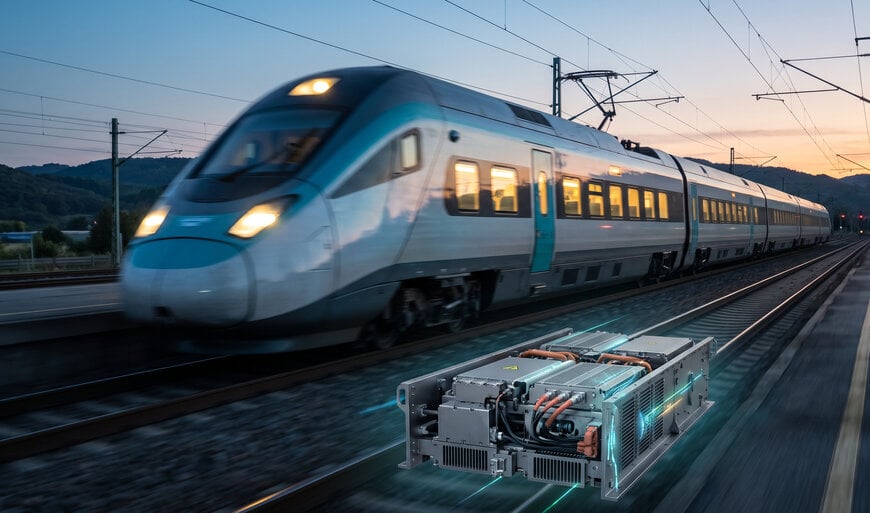
AI-generated image
Electric trains rely on power components called inverters to convert high-voltage electricity into the usable energy that drives their motors. For decades, these systems used standard silicon switches, which generated significant heat and wasted electricity in the process. Today, train builders are upgrading to an advanced material called silicon carbide (SiC). Because silicon carbide handles high voltages and hot temperatures much better than regular silicon, it lets electricity flow with far less wasted energy. This breakthrough also makes the equipment lighter and smaller, allows trains to run more quietly, and captures significantly more power whenever the train brakes to a stop.
Current Technology Market Landscape
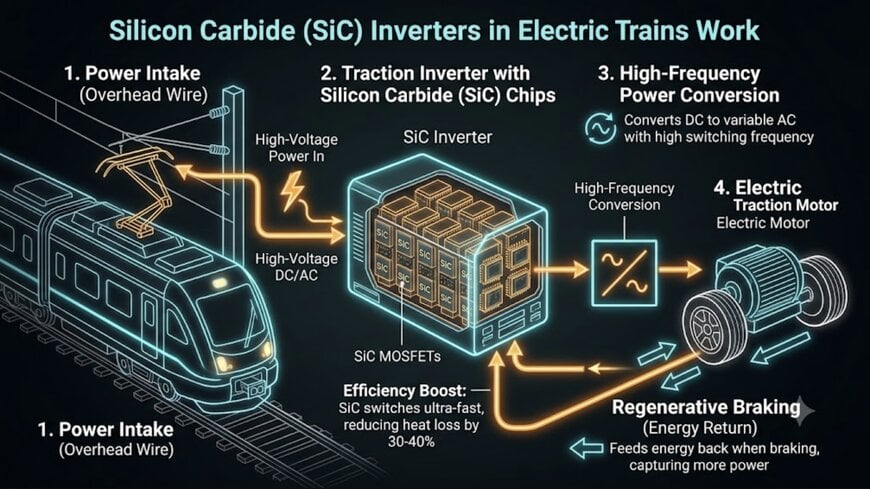
In high-voltage rail rolling stock, legacy silicon traction inverters operate at 750 V, 1,500 V, or 3,300 V, where Si-IGBT switching frequencies remain constrained to 500–1,500 Hz to prevent thermal runaway. SiC MOSFETs operate effectively at multi-kilohertz frequencies with higher thermal tolerances. These characteristics reduce inverter conversion energy losses between 30% and 40%, lower total traction block weight by 10% to 50%, and expand auxiliary regenerative energy savings across urban transit and intercity rolling stock.
Core Market Challenge
Widespread adoption faces industrial hurdles: high wafer manufacturing costs, high material defect densities, and packaging integrity under severe thermal cycling. SiC substrates cost significantly more than legacy silicon. Fast-switching high dv/dt transients also generate electromagnetic interference (EMI) and accelerate insulation stress on motor windings, requiring redesigns of gate drivers, EMI filtering, and cable shielding.
Existing Technology Solutions
Manufacturers employ distinct semiconductor packaging and propulsion strategies:
Mitsubishi Electric produces high-voltage Full-SiC and Hybrid-SiC power modules in-house. Its 3.3 kV / 800 A Full-SiC modules with embedded Schottky Barrier Diodes decrease switching losses by up to 66% compared to predecessor modules.
Hitachi Rail deploys full-SiC power module converters, achieving approximately 50% lower mounting footprints compared to equivalent-capacity Si-IGBT units, accompanied by a 13% reduction in overall traction housing weight.
Alstom incorporates silicon carbide into its Mitrac Power and Mitrac Supply platform, delivering up to a 51% reduction in converter volume and cutting traction acoustic emissions by 19 dBA.
Actual Implementation on the Ground
Mitsubishi Electric integrated 1,500 V DC All-SiC traction inverters into Odakyu Electric Railway 1000 Series trainsets, delivering verified overall power consumption reductions of approximately 36% to 40% compared to conventional silicon-based propulsion systems.
Hitachi supplied Full-SiC traction converters for JR West's 273 Series Yakumo express trainsets, shrinking underfloor propulsion volume to accommodate pendulum tilting mechanisms without sacrificing propulsion output.
Alstom deployed SiC auxiliary converters across regional and transit fleets, notably validating wide-bandgap units on metro cars in Stockholm and modern metro car platforms, drastically lowering energy draw, acoustic signatures, and equipment weight.
Summary and Strategic Future Outlook
Silicon Carbide power electronics are displacing legacy silicon IGBTs across rolling stock procurement frameworks. As 8-inch wafer processing matures and device prices normalize, high-voltage SiC systems will become the baseline standard for green mobility and heavy-haul railway applications.
Electric trains rely on power components called inverters to convert high-voltage electricity into the usable energy that drives their motors. For decades, these systems used standard silicon switches, which generated significant heat and wasted electricity in the process. Today, train builders are upgrading to an advanced material called silicon carbide (SiC). Because silicon carbide handles high voltages and hot temperatures much better than regular silicon, it lets electricity flow with far less wasted energy. This breakthrough also makes the equipment lighter and smaller, allows trains to run more quietly, and captures significantly more power whenever the train brakes to a stop.
Current Technology Market Landscape
In high-voltage rail rolling stock, legacy silicon traction inverters operate at 750 V, 1,500 V, or 3,300 V, where Si-IGBT switching frequencies remain constrained to 500–1,500 Hz to prevent thermal runaway. SiC MOSFETs operate effectively at multi-kilohertz frequencies with higher thermal tolerances. These characteristics reduce inverter conversion energy losses between 30% and 40%, lower total traction block weight by 10% to 50%, and expand auxiliary regenerative energy savings across urban transit and intercity rolling stock.
Core Market Challenge
Widespread adoption faces industrial hurdles: high wafer manufacturing costs, high material defect densities, and packaging integrity under severe thermal cycling. SiC substrates cost significantly more than legacy silicon. Fast-switching high dv/dt transients also generate electromagnetic interference (EMI) and accelerate insulation stress on motor windings, requiring redesigns of gate drivers, EMI filtering, and cable shielding.
Existing Technology Solutions
Manufacturers employ distinct semiconductor packaging and propulsion strategies:
Mitsubishi Electric produces high-voltage Full-SiC and Hybrid-SiC power modules in-house. Its 3.3 kV / 800 A Full-SiC modules with embedded Schottky Barrier Diodes decrease switching losses by up to 66% compared to predecessor modules.
Hitachi Rail deploys full-SiC power module converters, achieving approximately 50% lower mounting footprints compared to equivalent-capacity Si-IGBT units, accompanied by a 13% reduction in overall traction housing weight.
Alstom incorporates silicon carbide into its Mitrac Power and Mitrac Supply platform, delivering up to a 51% reduction in converter volume and cutting traction acoustic emissions by 19 dBA.
AI-generated image
Actual Implementation on the Ground
Mitsubishi Electric integrated 1,500 V DC All-SiC traction inverters into Odakyu Electric Railway 1000 Series trainsets, delivering verified overall power consumption reductions of approximately 36% to 40% compared to conventional silicon-based propulsion systems.
Hitachi supplied Full-SiC traction converters for JR West's 273 Series Yakumo express trainsets, shrinking underfloor propulsion volume to accommodate pendulum tilting mechanisms without sacrificing propulsion output.
Alstom deployed SiC auxiliary converters across regional and transit fleets, notably validating wide-bandgap units on metro cars in Stockholm and modern metro car platforms, drastically lowering energy draw, acoustic signatures, and equipment weight.
Summary and Strategic Future Outlook
Silicon Carbide power electronics are displacing legacy silicon IGBTs across rolling stock procurement frameworks. As 8-inch wafer processing matures and device prices normalize, high-voltage SiC systems will become the baseline standard for green mobility and heavy-haul railway applications.
Edited by Romila DSilva, Induportals Editor, with AI assistance.
www.railway-international.com
